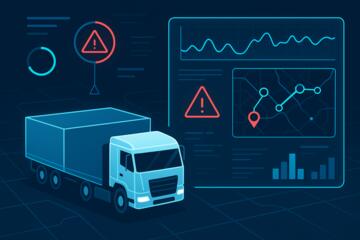
Transforming the Final Touchpoint with Machine Learning
In modern logistics, AI-driven optimization refers to the use of deep learning algorithms and neural networks to process vast datasets—weather, traffic, historical delivery windows, and vehicle capacity—to make split-second routing decisions. Unlike traditional static routing, which follows a fixed sequence, AI systems are dynamic. They perceive the city as a living organism, adjusting paths as accidents happen or as new "on-demand" orders enter the queue.
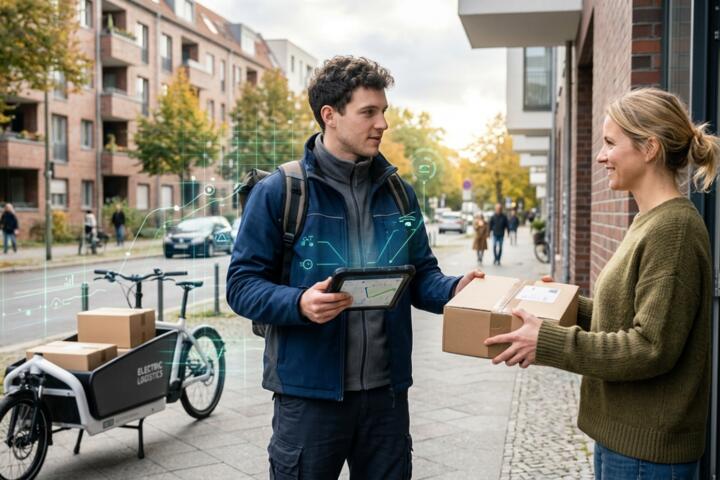
Consider a grocery delivery service in a dense urban environment like London. A traditional system might assign a driver 20 stops based on geographical proximity. However, an AI-driven system recognizes that at 4:00 PM, a specific school zone becomes congested, and a high-rise apartment on the route lacks available parking. The AI shifts the schedule to hit the high-rise at 3:15 PM and avoids the school zone entirely. Companies like Ocado have utilized similar predictive modeling to achieve over 95% on-time delivery rates while maintaining minimal idle time for their refrigerated fleet.
Recent industry data suggests that global last-mile delivery volume is expected to grow by 15-20% annually through 2026. A study by Capgemini revealed that 97% of organizations believe they cannot manage current delivery volumes without AI, especially as the "Green Delivery" movement pressures firms to reduce carbon footprints. Efficiency is no longer just about speed; it is about the mathematical reduction of miles traveled per parcel.
The Invisible Barriers to Delivery Profitability
The primary reason most delivery operations leak money is the reliance on "legacy intuition." Dispatchers often rely on their knowledge of a city, but human brains cannot calculate the permutations of 50 delivery stops across 10 vehicles simultaneously. This leads to the "Traveling Salesperson Problem" on a massive scale, where even a 5% error in route sequencing results in thousands of dollars in wasted fuel and overtime pay every month.
Failed delivery attempts represent a catastrophic pain point. When a customer isn't home or a gate code is missing, the cost of that parcel effectively doubles because it must be returned to the hub and re-dispatched. Without predictive "Estimated Time of Arrival" (ETA) windows, customers are left in the dark, leading to a surge in "Where Is My Order" (WISMO) calls. This puts an immense strain on customer support teams and erodes brand trust almost instantly.
Another overlooked issue is poor load optimization. Sending a half-empty van to a suburb while a motorcycle courier is overloaded in the city center is a common occurrence in fragmented logistics setups. Real-world situations often show couriers zig-zagging across the same neighborhood three times in one afternoon because the system treated each order as an isolated event rather than part of a cohesive spatial cluster. This lack of "territory density" is the silent killer of 3PL margins.
Predictive Routing and Dynamic Rerouting
AI doesn't just look at a map; it looks at history. By analyzing years of traffic patterns, tools like Route4Me or OptimoRoute can predict traffic jams before they happen. If a sudden rainstorm slows down traffic in Manhattan, the AI recalculates the entire fleet's route in seconds. This prevents the "domino effect" where one late delivery causes every subsequent delivery in the shift to fail its time slot.
Automated Dispatching and Fleet Balancing
Manual dispatching is the bottleneck of the warehouse. AI systems automate the assignment of tasks based on vehicle type (EV vs. internal combustion), driver skill, and current location. For instance, Bringg uses an orchestration platform that automatically pings the nearest available crowdsourced driver when a "hot" order is placed. This reduces the time between "order placed" and "out for delivery" from hours to minutes.
Hyper-Accurate ETA and Customer Communication
Trust is built through transparency. AI models analyze the average time a driver spends at a specific curb or inside a specific apartment complex to provide an ETA with a +/- 5-minute accuracy. Services like AfterShip or Convey provide automated, branded tracking pages that update in real-time. When customers see exactly where their package is, the rate of successful first-time delivery climbs by nearly 20%.
Smart Capacity and Load Planning
AI helps in "3D load building." By knowing the dimensions of every box and the interior volume of every van, systems can instruct loaders exactly how to pack the vehicle so that the first package to be delivered is the last one loaded. This minimizes the "sorting at the curb" time, which can save a driver up to 45 minutes over a full shift. Retailers using LogiNext have reported a 10% increase in vehicle utilization through these automated packing constraints.
Micro-Fulfillment and Urban Hub Optimization
To achieve 30-minute delivery, the inventory must be close to the customer. AI analyzes purchasing trends to suggest which items should be moved from a regional DC to a "dark store" or micro-fulfillment center (MFC) in the city. Using tools like Fabric or AutoStore, companies can automate these small hubs. If the AI sees an uptick in oat milk orders in a specific ZIP code, it triggers a restock of that MFC before the inventory even runs low.
Carbon Footprint Reduction and EV Integration
Sustainable logistics is now a regulatory requirement in many European cities. AI optimizes routes specifically for Electric Vehicles (EVs), accounting for charging station locations and the effect of payload weight on battery range. By reducing "empty miles"—distance traveled without a package—AI helps firms like DPD or DHL meet their net-zero targets while actually lowering their operational costs.
Real-World Success: From Chaos to Precision
A regional pharmacy chain in the Northeastern US faced a 14% failed delivery rate due to inaccurate windows for prescription drops. They implemented an AI-based route optimization layer that integrated with their POS system. By factoring in "door-to-door" time (the time it takes for a driver to walk from the van to the patient), they narrowed their delivery windows from 4 hours to 30 minutes. Within six months, failed deliveries dropped to 2%, and they reduced their fleet size by 3 vehicles while maintaining the same order volume.
A global furniture retailer struggled with the "last-mile assembly" component of their delivery. They used AI to balance the workload between drivers who were simple couriers and those trained in assembly. The system prioritized assembly-heavy routes for senior crews and ensured they had the necessary tools before leaving the hub. The result was a 25% increase in "first-time right" assemblies and a significant boost in their Net Promoter Score (NPS).
Strategic Implementation Checklist
| Phase | Action Item | Key Performance Indicator (KPI) |
|---|---|---|
| Data Audit | Clean historical delivery logs and verify address accuracy using geocoding APIs. | Geocoding Match Rate (>98%) |
| Tool Selection | Evaluate platforms based on API flexibility and real-time rerouting capabilities (e.g., Onfleet, Bringg). | Integration Time |
| Pilot Program | Deploy AI routing in one high-density ZIP code to compare against manual baselines. | Cost Per Delivery (CPD) |
| Customer Sync | Automate SMS alerts and live map tracking for the end-user. | WISMO Call Volume Reduction |
| Feedback Loop | Feed driver feedback on "unreachable" addresses back into the AI to improve map data. | First-Attempt Success Rate |
Navigating Common Implementation Hurdles
One frequent mistake is "garbage in, garbage out." If your address database is messy, the AI will provide perfect routes to the wrong locations. It is vital to use an address validation service (like Google Maps Platform or Loqate) at the point of checkout to ensure the data is actionable. Another error is ignoring driver feedback. If an AI consistently suggests a turn that is illegal for a truck, and the driver ignores the system, the data model becomes skewed. Always allow for a "human-in-the-loop" to flag physical constraints.
Over-reliance on automation without contingency is also risky. In the event of a cloud outage, dispatchers must have a "static backup" plan. Furthermore, many companies fail to account for the "settle-in" period. Drivers often resist new technology because they feel it monitors them too closely. Frame the AI as a tool that reduces their stress and helps them finish their shifts on time, rather than a "Big Brother" surveillance device. Engagement is the key to successful tech adoption.
Frequently Asked Questions
How much can AI really save on last-mile costs?
On average, businesses see a reduction of 15% to 25% in fuel costs and a 10% to 20% increase in stops per hour. The most significant savings come from the reduction in failed delivery attempts and the ability to use a smaller fleet more intensely.
Is AI routing only for large enterprises?
No. SaaS-based platforms have made this technology accessible to small and medium businesses. Modern tools offer "pay-per-stop" pricing models, allowing local bakeries or flower shops to use the same optimization logic as global giants.
Does AI replace the need for human dispatchers?
AI shifts the role of the dispatcher from manual data entry to "exception management." Instead of planning every route, the dispatcher only intervenes when the AI flags an anomaly it cannot solve, such as a vehicle breakdown or a warehouse delay.
What is the role of IoT in last-mile AI?
IoT sensors provide the "eyes" for the AI. Temperature sensors in cold-chain logistics, GPS trackers on bikes, and smart lockers all feed data back into the system to ensure the AI knows the status of every asset in real-time.
How does AI improve the "Green" aspect of delivery?
By drastically reducing idling time and ensuring the most efficient path is taken, AI inherently lowers CO2 emissions. It also enables "green slots," where customers can choose a delivery time when a van is already scheduled to be in their neighborhood.
Author’s Insight
In my years of consulting for mid-market logistics firms, I’ve noticed that the biggest gains don't come from the fanciest algorithms, but from the most integrated ones. If your routing software doesn't talk to your warehouse management system (WMS), you're only solving half the problem. My advice is to prioritize "Ease of Integration" over "Maximum Features." Start by solving the failed delivery problem—it’s the low-hanging fruit that pays for the rest of the AI implementation within the first quarter.
Conclusion
Optimizing the last mile through AI is no longer a luxury—it is a survival strategy in an era of razor-thin margins and high consumer expectations. By moving away from static planning and embracing dynamic, data-driven orchestration, companies can significantly reduce costs while enhancing the customer experience. To stay ahead, focus on data cleanliness, empower your drivers with intuitive tools, and choose scalable software that grows with your delivery volume. The future of logistics is not just about moving goods; it is about moving data intelligently to ensure every mile counts.