Introduction: The Future of Contract Review Is Here
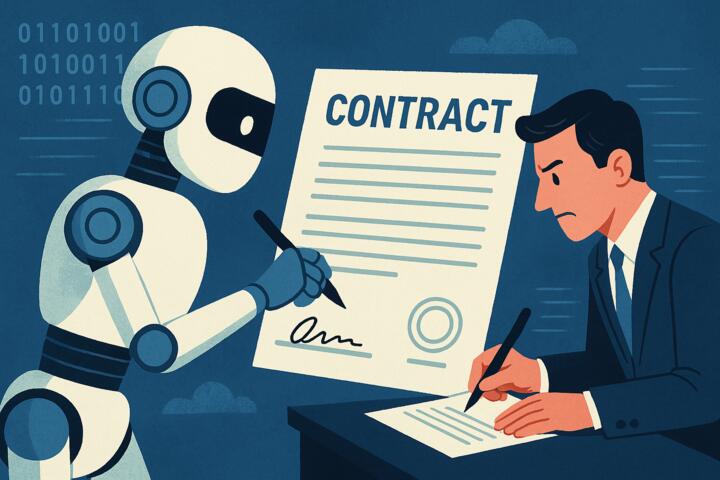
In today’s fast-paced business world, AI reviews contracts faster than humans, reshaping how legal teams and enterprises handle documents. Traditional contract review is time-consuming, repetitive, and prone to human error — especially when thousands of pages are involved. Artificial intelligence changes that by offering speed, precision, and scalability unmatched by manual methods.
According to Gartner, legal departments adopting AI-powered contract review tools can reduce document turnaround time by up to 70%. For law firms, this means lower costs and faster service; for corporations, it means greater compliance and reduced risk exposure.
Why Contract Review Is Critical for Every Business
Contracts are the backbone of every transaction — from vendor agreements to employment offers and mergers. A single overlooked clause can lead to costly disputes or compliance issues. Traditionally, teams of lawyers and paralegals spent hours combing through contracts line by line to ensure accuracy.
But as companies scale and cross-border deals multiply, this manual process simply can’t keep up. That’s where AI contract review software comes in, automating much of the heavy lifting.
How AI Reviews Contracts Faster Than Humans
AI-based systems rely on Natural Language Processing (NLP) and Machine Learning (ML) to read, understand, and analyze legal language. Here’s how the process works:
1. Document Ingestion and Categorization
AI can instantly scan thousands of documents, recognize contract types (NDAs, MSAs, leases, etc.), and organize them automatically.
2. Clause Detection and Comparison
Using trained models, AI identifies specific clauses — like indemnities, termination rights, or confidentiality terms — and compares them to standard templates or playbooks.
3. Risk Identification
AI flags potential red flags such as missing clauses, unusual payment terms, or non-compliant language, allowing humans to focus only on high-risk sections.
4. Data Extraction and Summarization
Tools like Kira Systems and Luminance extract critical data points (party names, renewal dates, obligations) into structured spreadsheets for faster analysis.
5. Continuous Learning
As legal teams correct or approve AI suggestions, the system learns and improves accuracy over time — similar to how junior associates learn from senior lawyers.
This process allows AI to review contracts 10x faster than humans, often with greater consistency.
Real-World Tools That Use AI for Contract Review
Several leading platforms have transformed the legal tech industry with AI-driven automation:
-
Luminance – Used by firms like Slaughter and May to analyze large-scale M&A transactions.
-
Kira Systems – Acquired by Litera, it helps law firms extract key clauses in seconds.
-
Ironclad – Automates contract lifecycle management for companies like Dropbox and Mastercard.
-
DocuSign CLM – Integrates e-signature workflows with AI-powered clause analysis.
-
Evisort – Backed by Microsoft and Vertex Ventures, it centralizes contracts and uses AI to track obligations and renewals.
Each of these platforms combines advanced NLP with intuitive dashboards, enabling both lawyers and non-legal staff to collaborate efficiently.
Key Benefits of AI-Powered Contract Review
1. Unmatched Speed
While human lawyers may take hours to review a 20-page contract, AI can process it in under a minute.
2. Improved Accuracy
AI reduces the risk of oversight by maintaining consistency across thousands of documents.
3. Cost Efficiency
By automating routine reviews, companies save on legal fees and staff hours, redirecting resources to strategic tasks.
4. Enhanced Compliance
AI ensures contracts adhere to internal policies and evolving regulations (GDPR, CCPA, etc.) automatically.
5. Scalability
When businesses expand globally, AI can handle multilingual contracts and diverse jurisdictional formats seamlessly.
According to PwC’s 2024 Legal Operations Survey, organizations using AI in contract management reported an average 35% reduction in operational risk and 50% faster deal closure rates.
Limitations: What AI Still Can’t Do
Despite its power, AI isn’t perfect. It lacks context, empathy, and ethical reasoning. Complex negotiations or ambiguous clauses still require human judgment.
Key limitations include:
-
Inability to interpret subjective intent behind contract terms.
-
Difficulty handling poorly scanned or handwritten documents.
-
Dependence on the quality of training data and human oversight.
In short, AI handles the “grunt work,” while lawyers remain essential for strategic interpretation and risk assessment.
Practical Tips for Using AI in Contract Review
1. Start with Low-Risk Documents
Begin with NDAs or standard supplier agreements before applying AI to complex M&A contracts.
2. Integrate with Existing Systems
Use AI tools that sync with your CRM, ERP, or document management system (e.g., Salesforce, NetSuite, or SharePoint).
3. Create a Clause Library
Standardize preferred clauses and use AI to flag deviations automatically.
4. Train Teams to Interpret AI Output
Lawyers should verify flagged risks and continuously refine the AI model.
5. Track Metrics
Measure KPIs like review time, accuracy, and cost reduction to evaluate ROI.
How Legal Teams Benefit from AI Review
AI isn’t replacing lawyers — it’s augmenting their capabilities. Here’s how modern teams benefit:
-
In-House Counsel: Focuses on negotiation and risk strategy instead of repetitive tasks.
-
Law Firms: Accelerates due diligence during M&A, saving billable hours.
-
Compliance Officers: Ensures all contracts align with corporate policies automatically.
-
Procurement Teams: Tracks renewal deadlines and vendor terms in real time.
For instance, EY’s Legal Managed Services team uses AI to process over 1 million contracts annually, cutting review time by 60%.
Common Mistakes to Avoid When Adopting AI
-
Ignoring Data Security – Ensure AI vendors comply with ISO 27001 and GDPR standards.
-
Expecting 100% Accuracy – Always include human review for final sign-off.
-
Skipping Training – Regularly update AI models with new contract templates.
-
Underestimating Change Management – Get stakeholder buy-in early to ensure smooth adoption.
-
Neglecting Integration – AI tools must connect with other business systems for maximum value.
Avoiding these pitfalls ensures your AI implementation is both efficient and compliant.
The Future of AI Contract Review
The next frontier of legal AI will combine Generative AI and predictive analytics. Tools like Harvey AI, used by Allen & Overy, already generate first drafts and suggest negotiation strategies.
Future systems will not only read contracts but also predict risks based on past litigation patterns and financial outcomes. Imagine AI that alerts you: “This clause increased dispute probability by 20% in similar deals.”
As MIT Sloan predicts, AI-assisted law will become standard practice across 80% of firms by 2030 — fundamentally changing the economics of legal work.
Author’s Insight
As someone who has worked closely with legal automation tools, I’ve seen firsthand how AI transforms legal teams from reactive to proactive. What once took a week — reviewing hundreds of NDAs — now happens in an afternoon.
However, the biggest shift isn’t just in speed; it’s in mindset. AI allows lawyers to focus on higher-value strategy instead of routine review. It turns legal departments from cost centers into innovation hubs.
My advice? Don’t fear automation — leverage it. The firms that integrate AI early will set the standard for efficiency and quality in the legal industry.
Conclusion: AI Is Redefining the Contract Review Process
In the digital era, where time equals opportunity, AI reviews contracts faster than humans, setting a new benchmark for legal efficiency.
By automating routine analysis, improving compliance, and reducing risk, AI empowers both in-house teams and law firms to focus on what truly matters — strategic decision-making and client relationships.
Adopting AI in contract review isn’t just a trend; it’s the next evolution in legal practice. Those who embrace it now will lead the industry’s future.