The New Standard for Operational Resilience
Traditional warehouse management systems (WMS) are excellent at tracking inventory but blind to the physical health of the facility. AI monitoring fills this visibility gap by using existing CCTV feeds and IoT sensors to create a continuous "digital twin" of floor operations. Instead of waiting for a conveyor belt to snap or a forklift to collide with a rack, these systems detect heat signatures, unusual vibrations, or pathing inefficiencies in real-time.
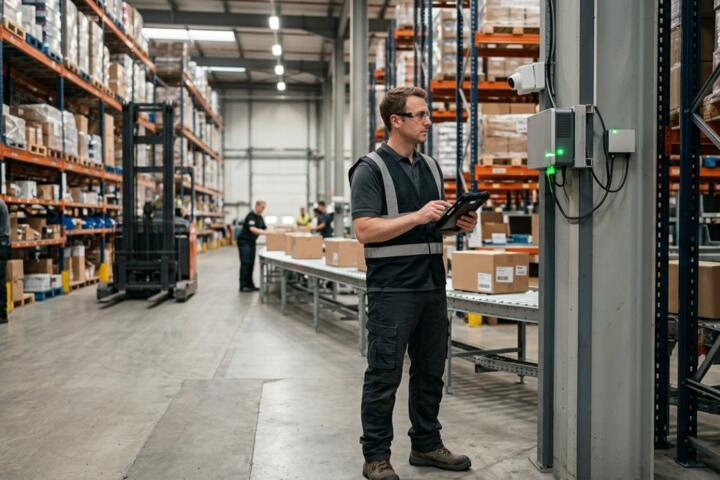
Consider a large distribution center where a critical sorter begins to deviate from its standard rhythmic vibration by only 3%. A human technician wouldn't notice this for weeks, but an AI model trained on millisecond-level data recognizes this as an impending bearing failure. According to a 2024 Deloitte study, AI-driven predictive maintenance can increase equipment uptime by 20% while reducing maintenance costs by nearly 10%.
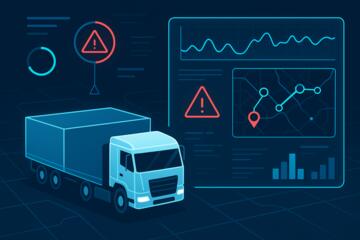
Practically, this looks like a dashboard alert at 2:00 AM notifying the night shift lead that "Motor 4B" is overheating. The repair happens during a scheduled 15-minute break rather than causing a four-hour emergency halt during peak shipping windows. This is the difference between controlled logistics and chaotic firefighting.
Why Traditional Monitoring Fails to Prevent Downtime
The primary mistake most facilities make is relying on "Run-to-Failure" (RTF) strategies. In an RTF model, maintenance only occurs after a breakdown. This is catastrophic in a high-velocity environment because modern warehouses are highly interdependent systems; if the palletizer stops, the entire outbound lane clogs within minutes. Human-led inspections are also prone to "observational fatigue," where staff overlook subtle signs of wear or safety hazards due to the repetitive nature of the job.
Furthermore, many warehouses suffer from "Data Silos." The telematics in the forklifts don't talk to the sensors on the conveyor, which don't talk to the labor management software. This fragmentation means managers only see the symptoms of downtime—like a drop in units per hour—rather than the root cause. A 2025 industry report highlighted that 70% of warehouse managers are unaware of the exact cause of their equipment failures until a third-party technician arrives on site.
The consequences are not just financial. Frequent unplanned downtime leads to employee burnout as staff struggle to meet quotas in shorter windows, which increases turnover rates. It also damages B2B relationships; missing a shipping window for a major retailer like Amazon or Walmart can result in hefty "chargeback" fines that eat into already thin margins.
Implementing Intelligent Monitoring: Strategies and Tools
Deploying Edge-Based Computer Vision
To reduce latency, top-tier facilities are moving AI processing to the "edge"—directly on the cameras or local servers. Systems like Viam or Azure Percept allow warehouses to analyze video locally. This is used for "Spill and Obstacle Detection." If a box falls off a tray and blocks a path, the AI triggers an immediate alert to the nearest floor worker's mobile device, clearing the path in seconds rather than waiting for a supervisor to spot it on a monitor.
Predictive Maintenance for Material Handling Equipment (MHE)
Using vibration sensors and thermal imaging from providers like Augury or Honeywell Forge, warehouses can monitor the "pulse" of their machinery. This works by establishing a baseline of "healthy" operation. When the AI detects a "signature shift" (e.g., a motor drawing 5% more current than usual), it logs a maintenance ticket automatically in your CMMS (Computerized Maintenance Management System).
Heat-Mapping for Traffic Flow Optimization
Congestion is a "silent" form of downtime. AI platforms like Pathlight or Cognex analyze the movement of forklifts and personnel. If the data shows that forklifts are idling for 120 seconds at a specific intersection, the AI suggests a rerouting plan. Implementing these changes has been shown to reduce internal travel time by 15%, effectively giving you back hours of operational time without adding staff.
Automated Safety Perimeter Auditing
Safety incidents are the most expensive form of downtime, often shutting down entire zones for investigations. AI monitoring tools like Intenseye or Voxel use existing cameras to detect "near misses"—situations where a forklift came too close to a pedestrian. By identifying these zones before an accident happens, companies can reconfigure layouts or retrain specific teams, preventing the multi-day shutdowns associated with OSHA investigations.
Integration with Digital Twin Simulations
Using platforms like NVIDIA Omniverse, managers can run "what-if" scenarios based on real-time monitoring data. If the AI predicts a 20% surge in volume for a holiday weekend, the digital twin can simulate where the bottlenecks will occur. This allows managers to proactively move maintenance windows forward, ensuring all equipment is at 100% capacity before the rush begins.
Inventory Accuracy and Slotting Optimization
Downtime often occurs when workers can't find items, leading to "picking stalls." AI-powered drones from Dexterity or Verity fly through the warehouse during off-hours, using computer vision to reconcile physical stock with the WMS. If an item is misplaced, the AI flags it. This ensures that when the shift starts, no time is wasted searching for "ghost" inventory, maintaining a steady flow of outbound shipments.
Success Stories: AI in the Field
Case Study 1: Global Electronics Distributor
The Challenge: A mid-sized distributor was experiencing 12 hours of unplanned conveyor downtime per month due to motor burnouts in their sorting wing. This resulted in approximately $180,000 in monthly lost revenue and missed shipping SLAs.
The Intervention: They installed Augury’s acoustic sensors on 50 critical motors. The AI was trained to recognize the sound of friction increase and coil overheating. Within 30 days, the system flagged a high-priority alert for a main drive motor that sounded "normal" to human ears.
The Result: The motor was replaced during a Sunday night maintenance window for $4,000. Had it failed during the Monday peak, the cost would have exceeded $50,000 in repairs and delays. Total downtime was reduced by 85% over six months.
Case Study 2: Fast-Moving Consumer Goods (FMCG) Warehouse
The Challenge: High forklift traffic was causing frequent "near-miss" collisions, leading to "slow-go" orders from safety officers that reduced picking speed by 30%.
The Intervention: The facility implemented Voxel’s AI safety platform. The system identified that a specific aisle’s blind spot was responsible for 70% of near-misses. They installed AI-triggered LED warning lights that flash when a forklift is approaching the intersection.
The Result: Safety incidents dropped by 92%, and because workers felt safer, the "slow-go" restrictions were lifted, returning the facility to its original throughput capacity while reducing insurance premiums by 12%.
Strategic Evaluation of AI Monitoring Tools
| Tool Category | Leading Providers | Primary Benefit | Implementation Time |
|---|---|---|---|
| Computer Vision Safety | Intenseye, Voxel | Prevents accidents and OSHA-related shutdowns | 4-6 Weeks |
| Predictive Maintenance | Augury, Honeywell Forge | Extends MHE lifespan; prevents motor failure | 2-3 Months |
| Workflow Analytics | Pathlight, Cognex | Eliminates congestion and pathing bottlenecks | 1-2 Months |
| Inventory Drones | Verity, Corvus Robotics | Reduces "searching" time and inventory gaps | 3-4 Weeks |
Common Pitfalls in AI Adoption
One frequent error is "Alert Fatigue." If you set your AI sensitivity too high, your maintenance team will receive 50 notifications a day for minor issues, leading them to ignore the system entirely. It is vital to categorize alerts by "Criticality" and only trigger floor-wide alarms for issues that pose an immediate shutdown risk. Start with a "Silent Mode" for the first two weeks to calibrate the AI against your specific environment.
Another mistake is neglecting the human element. Staff often view AI monitoring as "Big Brother" surveillance. To avoid resistance, reframe the technology as a tool for their protection and success. Show them how the AI helps them hit their bonuses by keeping the machines running smoothly and preventing back-breaking manual work during "catch-up" periods after a breakdown.
Finally, avoid "Point Solution Overload." Buying five different AI tools from five different vendors leads to a fragmented dashboard. Seek platforms that offer API integrations with your existing WMS and ERP. The goal is a "single pane of glass" where a manager can see everything from equipment health to safety compliance in one view.
Frequently Asked Questions
Does AI monitoring require replacing my existing cameras?
In most cases, no. Modern AI platforms are "hardware agnostic," meaning they can plug into your existing IP-based CCTV stream via an RTSP link. You may only need to upgrade to high-definition cameras in specific areas like high-speed sorting lanes or dark storage zones.
How long does it take to see a Return on Investment (ROI)?
Most facilities see a break-even point within 6 to 9 months. The ROI comes from three areas: reduced emergency repair costs, fewer labor hours spent on manual inspections, and the prevention of even one "catastrophic" multi-hour shutdown.
Is the data captured by AI monitoring secure?
Enterprise-grade AI providers use PII (Personally Identifiable Information) masking. The AI can detect that a "human" is in a dangerous zone without recording their face or specific identity, ensuring compliance with labor laws and privacy regulations like GDPR.
Can AI handle the dust and vibration of a heavy industrial warehouse?
Yes. Sensors designed for industrial use are typically IP67-rated, meaning they are dust-tight and waterproof. AI models are also trained to "filter out" the background noise and vibration common in warehouses to focus only on the anomalies.
Do I need an on-site data scientist to run these systems?
No. Most modern AI monitoring solutions are "SaaS-based" (Software as a Service). The complex modeling happens in the cloud or on a pre-configured local edge device. Your team interacts with a user-friendly dashboard designed for floor managers, not engineers.
Author’s Insight
In my years consulting for Tier-1 logistics firms, I’ve seen that the most successful AI implementations aren't the ones with the most expensive tech, but the ones that focus on "Small Wins." Don't try to automate the whole warehouse on day one. Start by monitoring your single biggest bottleneck—usually the primary sorter or the outbound dock. Once the team sees that the AI actually makes their shift easier by preventing a 3 PM breakdown, buy-in becomes effortless. My biggest piece of advice: trust the data even when it feels counterintuitive; if the AI says a motor is failing despite it looking fine, pull it for inspection—it's almost always right.
Conclusion
Reducing warehouse downtime is no longer about working harder during a crisis; it’s about deploying intelligence that prevents the crisis from occurring. By integrating computer vision, acoustic sensors, and predictive analytics, facilities can transform from reactive cost centers into proactive, high-efficiency hubs. To begin, conduct a "Downtime Audit" to identify your most frequent points of failure, then pilot an AI solution targeting that specific area. The transition to an AI-monitored facility is the only way to maintain a competitive edge in an era where shipping speed is the ultimate currency.