Mastering the Pulse of Periodic Market Surges
Predictive logistics isn't about guessing what will happen; it's about quantifying probability across thousands of variables. In the context of seasonal logistics, traditional "naive" forecasting—which assumes this December will look exactly like last December—fails because it ignores external disruptors like social media trends, sudden weather shifts, or port congestion. AI-enhanced systems utilize Deep Learning (DL) and Long Short-Term Memory (LSTM) networks to identify non-linear patterns that the human eye misses.
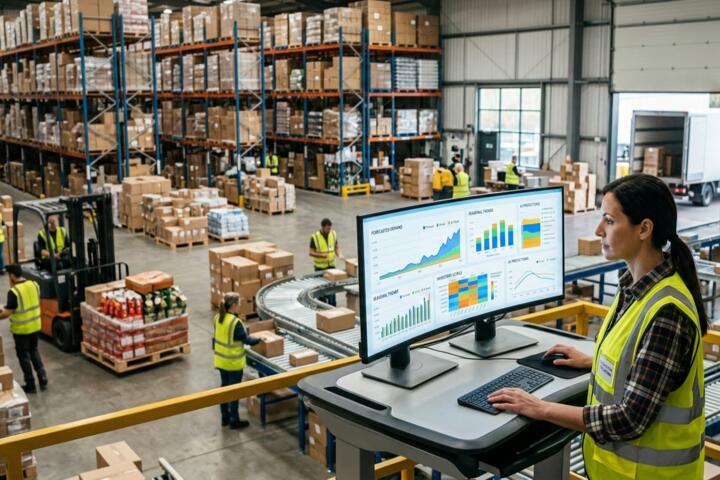
Consider a global apparel retailer preparing for "Black Friday." While a human planner sees a 20% increase in sales year-over-year, an AI model identifies that a specific color palette is trending 40% higher in certain urban zip codes due to localized influencer activity. By the time the season starts, the inventory is already pre-positioned in regional distribution centers, cutting "last-mile" shipping costs by up to 15%.
A report by McKinsey highlights that AI-powered supply chain management can reduce errors in forecasting by 30% to 50%. Furthermore, companies implementing these systems often see a reduction in lost sales of up to 65%, directly impacting the bottom line during the narrow windows of peak profitability.
The Cost of Conventional Calculation Errors
Most logistics firms struggle during peak seasons not because of a lack of effort, but because of data silos and "Recency Bias." Planners often over-weight the most recent month’s data, leading to the "Bullwhip Effect," where small fluctuations in consumer demand cause massive, expensive ripples in manufacturing and shipping.
The Silo Trap
Marketing runs a promotion on Shopify without telling the warehouse team. The resulting surge in orders leads to a backlog that takes weeks to clear, resulting in poor customer reviews and high return rates. Without a unified AI layer, these departments operate on different "versions of the truth."
The Buffer Waste
To avoid stockouts, managers often over-order by 25-30% "just in case." This ties up millions in capital and leads to massive "dead stock" that must be liquidated at a loss after the season ends. In the electronics sector, where product lifecycles are short, this can be a fatal financial blow.
Last-Mile Paralysis
During seasons like Christmas or Lunar New Year, carrier capacity disappears. Traditional forecasting focuses on what people buy, but ignores how it gets delivered. If your forecast doesn't account for carrier rate hikes or driver shortages, your high-demand items will sit in a warehouse while competitors use more agile, AI-routed delivery networks.
Tactical Implementation of Predictive Intelligence
Transitioning to an AI-driven model requires a shift from "descriptive" analytics (what happened) to "prescriptive" analytics (what should we do). Here is how to execute this shift with specific tools and methodologies.
Integrating External "Noise" Data
Standard forecasts use internal sales data. To win at seasonal logistics, you must ingest external data streams. This includes weather patterns from IBM Environmental Intelligence Suite or social sentiment from Brandwatch. If a cold snap is predicted for the Midwest, an AI model automatically adjusts the shipping priority for heavy winter gear to those specific regional hubs.
Granular SKU-Level Probabilities
Instead of forecasting "Category A," use AI to forecast at the SKU and Location level. Tools like Blue Yonder or o9 Solutions allow for "Probabilistic Forecasting." Instead of one number, you get a range of possibilities (e.g., an 80% chance of selling 500 units and a 20% chance of selling 800). This allows for "smart" safety stock levels rather than arbitrary buffers.
Automated Replenishment Triggers
Link your forecasting model directly to your procurement system via SAP IBP or Oracle SCM Cloud. When the AI detects a "velocity spike" that exceeds the standard deviation of normal seasonal growth, it can automatically trigger a purchase order or re-route an inbound shipment from a slower sea route to an expedited air freight lane.
Dynamic Labor Management
Seasonal demand isn't just about products; it's about people. Use AI to forecast "labor hours" required at the warehouse. If the forecast predicts a 400% surge in small-parcel shipments for Tuesday, the system prompts the HR module to increase temporary staff shifts for that specific window, preventing the bottleneck before it starts.
Resilience in Action: Realistic Success Stories
Case Study 1: The Mid-Sized Consumer Electronics Brand
A manufacturer of high-end kitchen appliances faced a 45% return rate and frequent stockouts during the holiday season. They implemented GMDH Streamline, an AI-driven platform that integrated their NetSuite ERP data with macro-economic indicators.
-
Action: The AI identified that their "seasonal peak" actually started 10 days earlier than their historical data suggested due to shifts in online shopping habits.
-
Result: They reduced "safety stock" levels by 22% while simultaneously increasing their fulfillment rate from 88% to 97%. This saved the company $1.4 million in holding costs in a single quarter.
Case Study 2: Fast-Fashion Agile Distribution
A regional fashion retailer was struggling with "End of Season" liquidation. They utilized AWS Forecast, using a "Prophet" algorithm to analyze 3 years of sales data alongside local weather and competitor pricing.
-
Action: The AI recommended a "Pre-Positioning" strategy, moving 30% of inventory to satellite "micro-fulfillment" centers based on localized demand clusters.
-
Result: Delivery times dropped from 4 days to 1.2 days, and "dead stock" at the end of the season was reduced by 18% compared to the previous year.
Comparative Framework for Forecasting Solutions
| Feature | Legacy Spreadsheets | Traditional Statistical (Moving Avg) | AI-Enhanced Forecasting |
| Data Sources | Historical Sales Only | Sales + Manual Trends | Sales, Weather, Social, Macro-Econ |
| Adaptability | Low (Manual Updates) | Moderate (Periodic) | High (Real-time Learning) |
| Granularity | Product Category | SKU Level | SKU + Location + Channel |
| Accuracy | 60-70% | 75-82% | 90-96% |
| Best For | Stable, Small Businesses | Established Mid-Market | High-Growth & Complex Logistics |
Common Pitfalls to Avoid
1. The "Set it and Forget it" Mentality
AI models require "Backtesting." You must regularly compare the AI's past predictions against actual results to "tune" the hyperparameters. If your model isn't learning from its misses, it’s just a fancy calculator.
2. Garbage In, Garbage Out (GIGO)
If your inventory data in your WMS (Warehouse Management System) is only 80% accurate, the AI will provide highly confident, yet completely wrong, recommendations. Conduct a full physical inventory audit before training your first machine learning model.
3. Ignoring the "Human in the Loop"
AI cannot predict "Black Swan" events like a sudden Suez Canal blockage or a global pandemic from historical data alone. Use AI to handle the 95% of "standard" seasonal volatility, but keep expert planners to handle the 5% of extreme anomalies.
FAQ
How much data do I need to start AI forecasting?
Ideally, you need at least two full seasonal cycles (24 months) of clean historical data. This allows the algorithm to distinguish between "noise" and actual seasonal patterns.
Is AI forecasting too expensive for mid-sized logistics firms?
No. Cloud-based SaaS models like Logility or Demand Caster offer tiered pricing that allows companies to pay for the computing power they use, making it accessible without a massive upfront CAPEX.
How does AI handle "New Product Introductions" (NPI) with no history?
AI uses "Attribute-Based Forecasting." It looks at the characteristics of the new product (color, price, category) and finds "look-alike" products in your history to create a baseline forecast.
Can AI reduce carbon footprints in logistics?
Yes. By optimizing routes and ensuring fuller truckloads through better demand placement, companies significantly reduce unnecessary mileage and fuel consumption.
What is the "Mean Absolute Percentage Error" (MAPE) and why does it matter?
MAPE is a key metric for forecast accuracy. A lower MAPE means your forecast is closer to reality. AI-driven systems typically lower MAPE by 10-15 points compared to manual methods.
Author’s Insight
In my years of consulting for high-volume distributors, I’ve noticed that the biggest hurdle isn't the technology—it's the "trust gap." Planners are often hesitant to follow an AI's suggestion when it contradicts their "gut feeling" developed over twenty years. However, the data is clear: the complexity of modern global trade has outpaced human cognitive limits. My advice is to start with a "Champion-Challenger" model. Let your human team and the AI run forecasts side-by-side for one quarter. When the AI consistently delivers a lower error rate, the organizational buy-in happens naturally. The future of logistics isn't about replacing the planner; it's about giving the planner a superpower.
Conclusion
Transitioning to AI-enhanced demand forecasting is no longer a luxury for the "Top 1%" of global logistics firms; it is a necessity for any business dealing with seasonal complexity. By integrating multi-dimensional data, utilizing probabilistic modeling, and breaking down departmental silos, organizations can transform their supply chain from a cost center into a competitive advantage. To begin, audit your current data cleanliness and pilot an AI module on your most volatile "High-Value" SKU category. Small, data-driven wins in accuracy today will compound into significant operational resilience during your next peak season.