Sustaining High-Performance Cultures Through Intelligent Automation
The contemporary workplace is currently battling a "productivity paradox." Despite an influx of digital tools, the World Health Organization identifies burnout as a primary occupational phenomenon resulting from chronic workplace stress that hasn't been successfully managed. For a manager, burnout isn't just a HR metric; it is a systemic failure of workflow design.

Artificial Intelligence (AI) serves as a cognitive offloader. It is no longer about simple "if-this-then-that" automation, but rather about using Large Language Models (LLMs) and machine learning to handle the nuance of scheduling, documentation, and data synthesis. For instance, a project manager at a mid-sized tech firm might spend 12 hours a week simply updating Jira tickets and summarizing meeting notes. By deploying an AI layer, that time is slashed to 45 minutes, allowing for more empathetic 1-on-1 coaching.
Recent data from Microsoft’s Work Trend Index indicates that 68% of people say they don’t have enough uninterrupted focus time during the workday. Furthermore, managers are 3.5 times more likely to say they are struggling with balancing their workload compared to individual contributors. AI is the only scalable solution to this math problem.
The Cognitive Debt: Why Traditional Management Is Failing
Managers often fall into the trap of "performative productivity"—the belief that being visible in every thread and meeting equals effective leadership. This creates a bottleneck effect where the manager becomes a single point of failure.
The primary pain point is the fragmentation of attention. When a manager switches between a budget spreadsheet, a Slack firestorm, and a strategic deck, they incur a "switching cost" that reduces functional IQ by up to 10 points. This mental fatigue leads to poor decision-making and emotional irritability, which then trickles down to the team, creating a toxic feedback loop of stress.
Another critical error is the manual tracking of employee sentiment. By the time a manager notices a team member is disengaged through traditional quarterly reviews, the employee has likely already checked out or started interviewing elsewhere. Relying on hindsight is a recipe for high turnover and depleted team morale.
Strategic AI Implementation to Reclaim Team Bandwidth
Automating the Administrative "Tax"
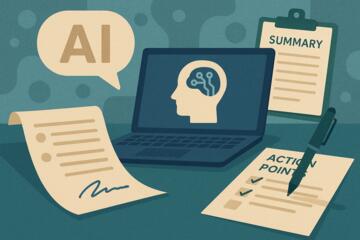
The most immediate way to reduce overload is to eliminate the manual recording of information. Every meeting generates administrative debt—action items, transcripts, and follow-ups.
How it works: Use tools like Otter.ai or Fireflies.ai to record and categorize meetings. Instead of a human spending an hour writing a recap, the AI generates a bulleted list of commitments and deadlines immediately.
The Result: A 40% reduction in time spent on post-meeting administration.
Predictive Workload Balancing
Managers often assign tasks to the "willing," leading to the burnout of high-performers. AI-driven project management tools analyze historical velocity to predict when a team member is reaching a breaking point.
Tools and Methods: Platforms like Resource Guru or Forecast.app use algorithms to visualize team capacity. If the AI detects that a developer has 50 hours of tasks assigned for a 40-hour week, it flags the conflict before the week even begins.
The Result: Balanced workloads that prevent the "hero culture" from destroying top talent.
Intelligent Inbox and Communication Triage
The average manager receives over 120 emails a day. The "Always On" culture is a primary driver of chronic stress.
Implementation: Use SaneBox or Shortwave to categorize incoming mail based on urgency and relationship depth. Additionally, AI agents like Motion can automatically reschedule meetings based on your priority list, ensuring that deep work blocks are never interrupted by non-urgent syncs.
The Result: An extra 2 hours of "Deep Work" daily, which is critical for long-term strategic thinking.
Real-Time Sentiment Analysis
Understanding team health shouldn't be a guessing game. AI can monitor the "digital exhaust" of a company to provide early warnings.
Tools: Services like Lattice or Culture Amp (with AI features) analyze the tone of open-ended feedback and pulse surveys to identify departments at risk of turnover. Some advanced teams use Viva Insights to see if employees are working too many late-night hours, allowing managers to intervene before the burnout is physical.
Practical Success Stories: AI in the Trenches
Case Study 1: Scaling a Marketing Agency
A digital marketing agency with 50 employees struggled with creative burnout. Account managers were spending 15 hours a week on client reporting.
The Solution: They integrated Mora for automated data visualization and Jasper for initial content drafting.
The Result: Reporting time dropped to 2 hours per week. Employee retention increased by 22% over 12 months because the "grind" was replaced by high-level creative strategy.
Case Study 2: Engineering Lead Efficiency
A Lead Engineer at a fintech startup was overwhelmed by code reviews and documentation.
The Solution: The team implemented GitHub Copilot and Stepsize AI. The AI began drafting documentation as the code was written and summarized technical debt weekly.
The Result: The Lead Engineer reclaimed 10 hours a week, which they redirected toward mentoring junior devs. The "overload" feeling reported in internal surveys dropped from 8/10 to 3/10.
Managerial AI Tool Comparison
| Category | Recommended Tools | Primary Benefit | ROI Metric |
| Meeting Intelligence | Otter.ai, Fireflies, Grain | Eliminates manual note-taking | 5-7 hours saved/week |
| Scheduling | Motion, Reclaim.ai | Protects focus time via auto-blocking | 20% increase in deep work |
| Drafting & Synthesis | Jasper, ChatGPT (Plus), Copy.ai | Speeds up emails and reports | 3x faster first drafts |
| Project Tracking | Monday.com (AI features), Asana | Predicts deadline risks | 15% reduction in missed dates |
| Mental Health | Headspace for Teams, Ginger | Provides on-demand support | 30% reduction in stress claims |
Critical Pitfalls in AI Adoption
One major mistake is "The Automation Overload"—introducing too many tools at once. This creates "tool fatigue," where the team spends more time managing the AI than doing the work. A manager should introduce one AI solution per quarter, ensuring it is fully integrated into the culture before moving to the next.
Another error is the "Set and Forget" mentality. AI is a co-pilot, not an autopilot. If a manager uses AI to generate feedback for an employee without reviewing it, the lack of human empathy will be felt immediately, damaging trust. Always maintain a "Human-in-the-Loop" (HITL) workflow. AI should provide the data and the draft, but the manager provides the soul and the final decision.
Lastly, avoid using AI for surveillance. Using AI to track mouse movements or keystrokes is the fastest way to destroy psychological safety. Use AI to empower, not to police.
FAQ: Frequently Asked Questions
Does AI replace the need for 1-on-1 meetings?
No. It enhances them. By using AI to handle the status updates, the 1-on-1 can focus entirely on career development and emotional support.
How do I justify the cost of AI tools to my CFO?
Frame it in terms of "Time Reclaimed." If a manager earning $120k/year saves 5 hours a week via AI, that is a $15,000 annual return on a tool that likely costs $300/year.
Will my team be afraid that AI is replacing them?
Transparency is key. Explain that AI is replacing the tasks they hate, not the jobs they have. Focus on "Augmentation, not Replacement."
What is the best AI tool for a beginner manager?
Start with a meeting assistant like Fireflies. It provides immediate value by allowing everyone to be "present" rather than typing.
Is my data safe with these AI tools?
Most enterprise-grade tools (like ChatGPT Team/Enterprise or Microsoft 365 Copilot) offer data protection where your inputs aren't used to train the global model. Always check for SOC2 compliance.
Author’s Insight
In my years observing leadership trends, the most successful managers aren't those with the most grit, but those with the best systems. I’ve personally found that the "Sunday Night Scaries"—that heavy feeling of the week ahead—usually stem from a lack of clarity, not a lack of time. When I started using AI to categorize my team’s blockers before our Monday stand-up, my own stress levels plummeted. My advice is to pick the one task you dread the most this week and ask: "How can a prompt or a bot take 70% of this off my plate?" The goal of AI isn't to make us more like machines; it's to give us the space to be more human.
Conclusion
Reducing burnout requires a shift from manual oversight to algorithmic assistance. By utilizing AI for meeting synthesis, workload balancing, and communication triage, managers can effectively eliminate the "shadow work" that leads to exhaustion. Start by auditing your calendar, identifying repetitive cognitive tasks, and delegating them to a specialized AI tool. The result is a more resilient, focused, and creative team that performs because they have the mental space to do so, not because they are being pushed to their limits.