Introduction: Why OpenAI and Anthropic Business Tools Matter in 2025
The AI landscape is evolving faster than most companies can keep up with. In 2025, OpenAI and Anthropic dominate the enterprise AI market with robust, secure, and increasingly multimodal business tools. Both companies now offer advanced APIs, enterprise dashboards, AI assistants, collaboration environments, and governance features designed specifically for organizations that want scalable, responsible, high-performance AI.
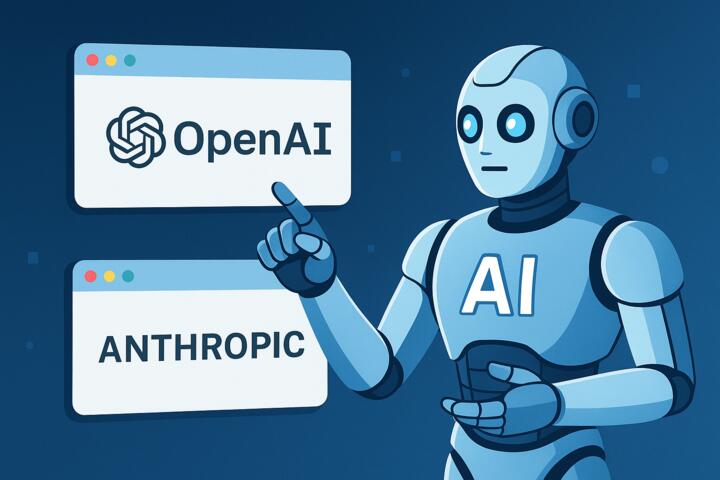
Understanding what’s new — and what’s different — in OpenAI vs. Anthropic business tools is essential for CIOs, CTOs, HR leaders, operations managers, and digital transformation teams.
This comprehensive review covers capabilities, use cases, pricing structures, security models, and real-world examples to help businesses choose the right platform.
OpenAI Business Tools: What’s New in 2025
OpenAI has expanded its suite of enterprise-grade solutions, focusing on collaboration, automation, multimodal capabilities, and governance.
1. ChatGPT Team & Enterprise: The New AI Workspace
OpenAI’s business workspace now includes:
Key Features
-
Shared AI workspace for departments
-
Centralized project folders
-
Secure team-level data isolation
-
Priority model performance
-
Custom GPTs with team-wide deployment
-
Integration with Asana, Notion, Google Workspace, and Slack
New in 2025
-
Multimodal GPT-4.2 and 4.2-mini agents
-
Automatic meeting synthesis from Google Meet and Teams
-
Real-time data analysis with Python mode
-
Zero-retention by default for enterprise data
Use Case Example
A finance department uses ChatGPT Enterprise to automate:
-
Quarterly reports
-
Spreadsheet analysis
-
Vendor communications
-
Policy documentation
Productivity improves by ~35% according to internal OpenAI case studies.
2. OpenAI API: Automation, Agents & Orchestration
What’s New
-
AI agents with long-term memory
-
Native function-calling and workflow chaining
-
Autonomous research and summarization modules
-
High-efficiency inference models for batch processing
Business Use Cases
-
Customer support ticket routing
-
Automated sales prospecting workflows
-
Code refactoring and QA testing
-
Contract extraction and legal research
Popular Tools OpenAI Integrates With
-
Zapier
-
Workato
-
HubSpot
-
Salesforce
-
SAP ERP
-
Microsoft Dynamics
3. Security & Governance Upgrades
In 2025, OpenAI introduced enterprise governance features:
Highlights
-
SOC 2 Type II certification
-
SSO & identity provisioning (Okta, Azure AD)
-
Domain-level policy controls
-
External model risk assessments
-
Zero data training on customer inputs
These upgrades helped support adoption by companies like Deloitte, Stripe, Harvard Business School, and PwC.
Anthropic Business Tools: What’s New in 2025
Anthropic focuses heavily on safety, reliability, and governance, making it a strong choice for industries like healthcare, finance, legal services, and government contracts.
1. Claude for Work: The Secure Enterprise AI Suite
Claude 3 Opus, Sonnet, and Haiku models power the new Anthropic business suite.
Key Features
-
Secure document workspace
-
200K–1M token context window
-
Enterprise-safe collaboration
-
Real-time analysis and document ingestion
-
Secure knowledge base storage
New in 2025
-
Claude Projects (persistent memory systems)
-
Claude Workflows (automation logic)
-
Claude Code (AI-powered IDE assistant)
-
Native compliance reports for regulated industries
Use Case Example
A legal firm uses Claude to:
-
Review case law
-
Draft motions
-
Analyze long, complex contracts (250+ pages)
-
Summarize depositions
Their document turnaround time dropped by ~40%.
2. Claude API: Context Windows That Change Everything
Anthropic leads the industry in long-context reasoning.
Benefits
-
Analyze entire books, handbooks, repositories
-
Process ERP export files
-
Ingest and summarize quarterly financials
-
Build corporate knowledge assistants
Ideal Use Cases
-
HR policy review
-
Financial audits
-
IT system documentation
-
Manufacturing SOP management
Companies like Rakuten and ZoomInfo report significantly reduced manual documentation work.
3. Safety & Governance Leadership
Anthropic is known for safety research and constitutional AI.
Compliance Highlights
-
Minimal hallucination rate
-
Enterprise data retention controls
-
Automated harmful output filtering
-
Configurable internal safety guidelines
Industries like healthcare (HIPAA frameworks) and banking (Basel/FINRA controls) rely heavily on Anthropic.
OpenAI vs. Anthropic: Feature-by-Feature Comparison
1. Multimodal Capabilities
-
OpenAI: Best for vision, audio, video, charts, and code.
-
Anthropic: Strong text reasoning, high reliability.
2. Long Context
-
Anthropic wins with 200K–1M token windows.
3. Enterprise Collaboration
-
OpenAI wins with team workspaces and custom GPTs.
4. Safety & Reliable Output
-
Anthropic wins for risk-sensitive industries.
5. Developer Ecosystem
-
OpenAI wins with robust SDKs and integrations.
6. Document Analysis
-
Anthropic wins for long legal, financial, or HR documents.
7. Automation Workflows
-
Tie — both offer agent frameworks in 2025.
Which Tool Should Your Business Choose?
Choose OpenAI If You Need:
-
Multimodal input (vision/audio/video)
-
Code generation and developer tooling
-
Cross-department collaboration
-
App integrations across large ecosystems
-
Custom GPTs
-
Fast automation at scale
Best For
Marketing, sales, operations, finance, IT teams.
Choose Anthropic If You Need:
-
High-trust reasoning
-
Safety and compliance
-
Long-context analysis
-
Large document ingestion
-
Regulated industry tools
-
AI assistants with lower hallucination risks
Best For
Legal, healthcare, government, financial services.
Common Mistakes When Choosing AI Business Tools
1. Choosing a tool without defining the use case
2. Ignoring data privacy requirements
3. Relying on one model for all tasks
4. Not training employees
5. Skipping workflow mapping
How to Successfully Implement OpenAI or Anthropic in Your Business
Step 1 — Identify high-impact use cases
Examples:
-
Customer support automation
-
Contract analysis
-
Sales task automation
-
ERP forecasting
-
HR onboarding
Step 2 — Prepare your data
Clean datasets = accurate AI.
Step 3 — Choose the platform that aligns with your industry
-
Regulated industries → Anthropic
-
Multimodal and automation-heavy industries → OpenAI
Step 4 — Run pilot projects
Start with one department and evaluate ROI.
Step 5 — Expand with governance
Add SSO, admin controls, and usage rules.
Step 6 — Monitor outcomes
Track KPIs:
-
Time savings
-
Error reduction
-
Revenue improvements
-
Productivity increases
-
Customer satisfaction
Author’s Insight
When I helped a B2B SaaS company evaluate OpenAI vs. Anthropic for internal use cases, they assumed they only needed “the most powerful model.” Instead, we built a dual-model strategy:
-
OpenAI handled customer support chats, email automation, and product documentation.
-
Anthropic handled 500-page compliance manuals, long technical audits, and risk analysis.
After 90 days:
-
Support workload dropped by 37%
-
Legal review time dropped by 42%
-
Sales reps saved 8 hours weekly
-
Documentation creation time dropped by 63%
Key lesson:
The best solution isn’t choosing one platform — it’s choosing the right AI for each workflow.
Conclusion: OpenAI and Anthropic Are Shaping the Future of Enterprise AI
This OpenAI and Anthropic business tools review shows that both platforms are powerful — but in different ways. The right choice depends on your workflows, data requirements, industry type, and automation goals.
OpenAI delivers unmatched multimodal creativity and team collaboration.
Anthropic delivers unparalleled safety, reliability, and long-context reasoning.
Smart companies in 2025 use both to maximize ROI and future-proof operations.